
Hawaii Spinner Dolphin
- Scientific Name: Stenella longirostris
- Length: 4.6-6.7 feet
- Weight: 143-172 pounds
- Status: Population unknown, but it’s common
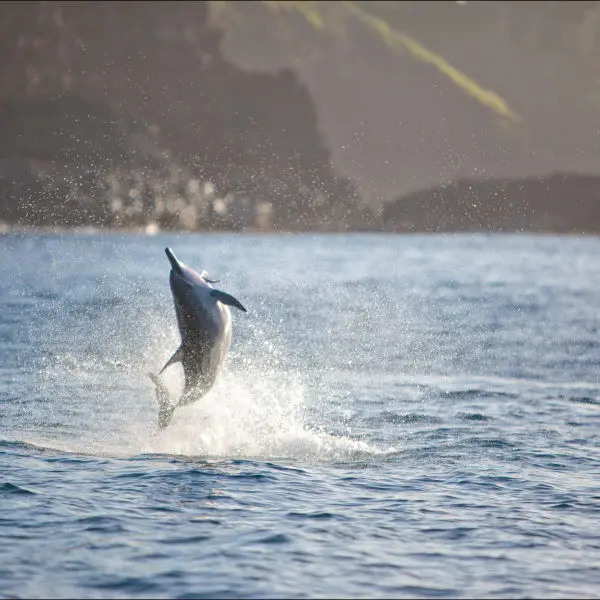
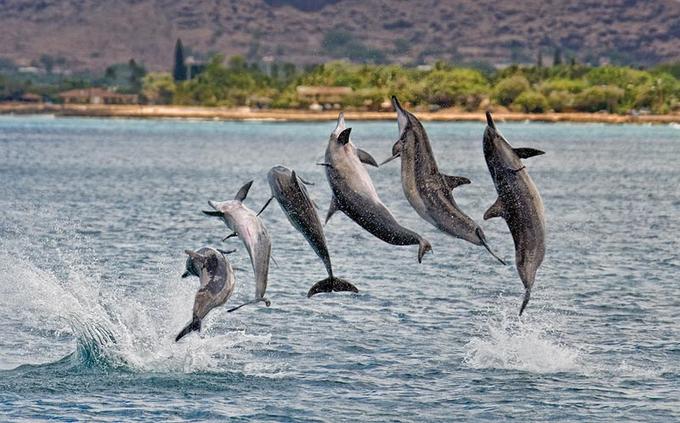
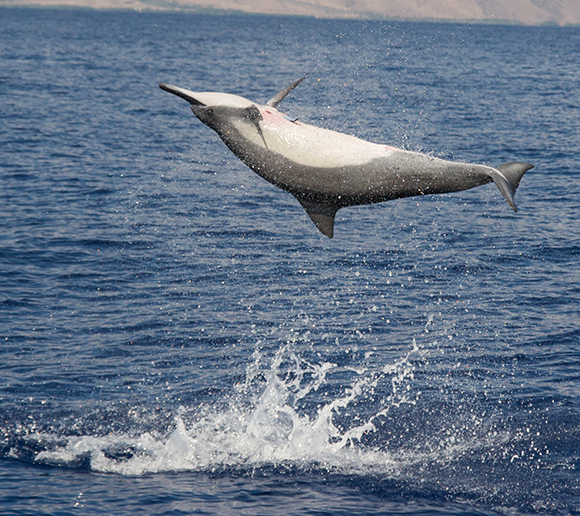
The most common and smallest dolphin seen around the islands of Hawaii. The are playful, follow boats, engage with swimmers and divers and are very friendly. The Hawaii Spinner Dolphin gets its name from the the ability to spin their body around when they leaps out of the water.
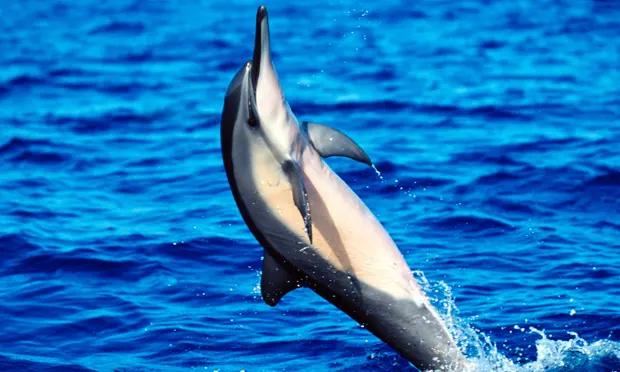
Spinner dolphins are probably the most frequently encountered cetacean in nearshore waters of the Pacific Islands Region. Spinner dolphins received their common name because they are often seen leaping and spinning out of the water. The species’ name, longirostris, is Latin for “long beak,” referring to their slender shaped beak or rostrum.
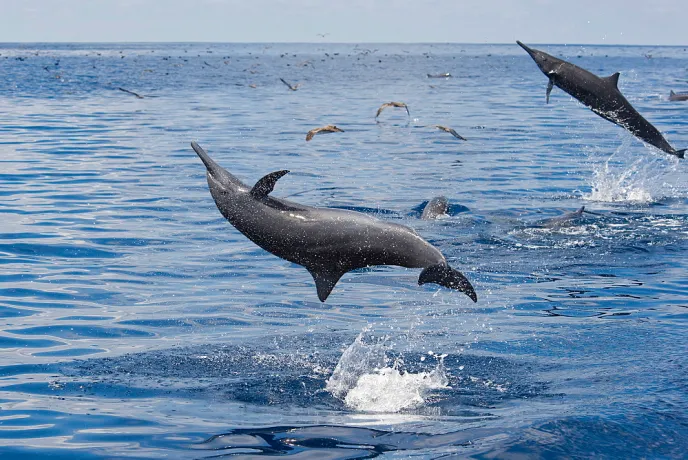
Regarded as one of the most acrobatic of dolphins, spinner dolphins are well known for their habit of leaping from the water and spinning up to seven times in the air before falling back into the water. Experts believe that spinner dolphins use these behaviors primarily for acoustic signaling or communication, but the activity can also be a way to remove ectoparasites, such as remoras
Behavior and Diet
Spinner dolphins feed at night on species including small fish, shrimp, and squid that are found about 650 to 1,000 feet below the surface of the water. Spinner dolphin prey species follow a vertical and horizontal migration pattern, staying in deep waters in the ocean during the day, and then moving up in the water column (vertical migration) and inshore (horizontal migration) at night. Spinner dolphins take advantage of the nightly migration that brings their prey species to shallower depths and closer to shore by feeding throughout the night.
When resting, spinner dolphins move back and forth slowly as a single unit, with the animals in tight formation but spaced just out of contact with one another. They may engage in resting behaviors for about four to five hours daily. This behavior may vary seasonally, coinciding with the shifts in day length. During rest, spinner dolphins rely on vision rather than echolocation for scanning their environment. Group movements during rest are typically in open, sandy-bottom areas where predators are more visible.
At the end of their rest period, spinner dolphins usually abruptly increase their activity level, including their swim speeds, aerial behaviors, vocalizations, and make shorter dives than when resting. In 1994, researchers described spinner dolphins swimming in a “zig-zag” pattern following their rest period. They swam toward the open waters and then doubled back into shallower waters. This back-and-forth swimming repeats a zig-zag formation over most of the area, possibly functioning as a social cue for the entire group to coordinate their movement into the deeper seas. Likewise, the dolphins’ acoustic behaviors rise and fall synchronously with the zig-zag swimming patterns. When these patterns subside, the spinner dolphins swiftly race to the offshore waters of their foraging grounds, where they are sometimes joined by bottlenose or spotted dolphins. At this point, spinner dolphins’ dive times are extended and the dolphins begin their foraging movements
Marine Debris
Marine debris is a growing concern within the marine environment, as it poses multiple threats to the marine ecosystem. For instance, spinner dolphins may ingest (either directly or through prey items) or become entangled in marine debris. These interactions may cause:
- Drowning
- Debilitation
- Limited predator avoidance
- Internal or external wounds
- Skin lesions or sores
- Blockage of the digestive tract, resulting in starvation that often leads to death
- Reductions in quality of life and/or reproductive capacity
- Impairment of feeding capacity
- Introduction and/or concentration of damaging or toxic compounds to the animal
The severity of the effects of debris interactions on all dolphin populations remains unclear because many deaths likely occur undetected at sea
We do not have sufficient information to determine the severity of the threat of direct ingestion of large debris on spinner dolphin populations. Some data indicates that spinner dolphin prey species are consuming very small plastics. In 2010, researchers analyzed mesopelagic fish in the North Pacific Central Gyre and found that 35 percent of the fish—many of which were lantern fish (spinner dolphins’ main prey)—had ingested plastic. Larger fish generally had more pieces of plastic in their guts than smaller fish. We are particularly concerned about the ability for plastic debris to absorb organic pollutants that may be toxic to the marine organisms that ingest them. These contaminants can bioaccumulate as they move up the food chain to top predators such as spinner dolphins. Scientists have also found high levels of butyltin and organochlorine (chemical compounds found in some plastics) in migrating lantern fish species in the Western North Pacific, which may indicate a cause for concern for predators, such as spinner dolphins.
Human-Made Noise
Humans introduce sound intentionally and unintentionally into the marine environment. This could be from commercial and recreational ocean activities, navigation, oil and gas exploration and acquisition, research, and military activities. Spinner dolphins use sound to communicate, navigate, locate prey, locate predators, and sense their environment, which can be impacted by introduced anthropogenic noise How severely noise exposure affects dolphins and whales depends on factors including:
- Noise source
- Decibel level
- Distance between the source and the animal
- Characteristics of the animal (for example, hearing sensitivity, behavioral context, age, sex, and previous experience with sound source)
- Time of day or season (which affects how sound travels through the water)
In marine mammal populations, noise can seriously disrupt communication, navigational ability, and social patterns.
Disease
Spinner dolphins, like all marine mammals, can be susceptible to widespread disease. Outbreaks in spinner dolphins are not commonly reported, but scientists have previously detected serious diseases, such as toxoplasmosis and cetacean morbillivirus. Although the number of spinner dolphin deaths attributed to these diseases is fairly low (many are thought to be unreported), thousands of other marine mammal species have died from these diseases worldwide.