

Hawaii Spinner Dolphin
Can the dolphins be animated floating center page
- Scientific Name: Stenella longirostris
- Length: 4.6-6.7 feet
- Weight: 143-172 pounds
- Status: Population unknown, but it’s common
The most common and smallest dolphin seen around the islands of Hawaii. The are playful, follow boats, engage with swimmers and divers and are very friendly. The Hawaii Spinner Dolphin gets its name from the the ability to spin their body around when they leaps out of the water.
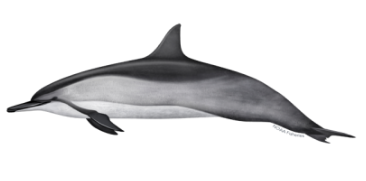
Spinner dolphins are probably the most frequently encountered cetacean in nearshore waters of the Pacific Islands Region. Spinner dolphins received their common name because they are often seen leaping and spinning out of the water. The species’ name, longirostris, is Latin for “long beak,” referring to their slender shaped beak or rostrum.
Regarded as one of the most acrobatic of dolphins, spinner dolphins are well known for their habit of leaping from the water and spinning up to seven times in the air before falling back into the water. Experts believe that spinner dolphins use these behaviors primarily for acoustic signaling or communication, but the activity can also be a way to remove ectoparasites, such as remoras.
Behavior and Diet
Spinner dolphins feed at night on species including small fish, shrimp, and squid that are found about 650 to 1,000 feet below the surface of the water. Spinner dolphin prey species follow a vertical and horizontal migration pattern, staying in deep waters in the ocean during the day, and then moving up in the water column (vertical migration) and inshore (horizontal migration) at night. Spinner dolphins take advantage of the nightly migration that brings their prey species to shallower depths and closer to shore by feeding throughout the night.
When resting, spinner dolphins move back and forth slowly as a single unit, with the animals in tight formation but spaced just out of contact with one another. They may engage in resting behaviors for about four to five hours daily. This behavior may vary seasonally, coinciding with the shifts in day length. During rest, spinner dolphins rely on vision rather than echolocation for scanning their environment. Group movements during rest are typically in open, sandy-bottom areas where predators are more visible.
At the end of their rest period, spinner dolphins usually abruptly increase their activity level, including their swim speeds, aerial behaviors, vocalizations, and make shorter dives than when resting. In 1994, researchers described spinner dolphins swimming in a “zig-zag” pattern following their rest period. They swam toward the open waters and then doubled back into shallower waters. This back-and-forth swimming repeats a zig-zag formation over most of the area, possibly functioning as a social cue for the entire group to coordinate their movement into the deeper seas. Likewise, the dolphins’ acoustic behaviors rise and fall synchronously with the zig-zag swimming patterns. When these patterns subside, the spinner dolphins swiftly race to the offshore waters of their foraging grounds, where they are sometimes joined by bottlenose or spotted dolphins. At this point, spinner dolphins’ dive times are extended and the dolphins begin their foraging movements.
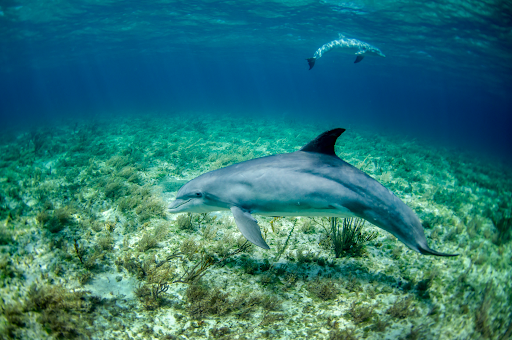
The Spotted Dolphin
- Scientific Name: Stenella attenuataare
- Length: 7 feet
- Weight: 290 products
- Status: Gathering numbers and data
The Spotted Dolphin is easy to spot due to its “spots”. They are slightly larger than the Hawaii Spinner Dolphin also friendly. This species of dolphin can be seen around the world with slight variations. Their age can be determined by the spots and color of their nose. The other name for their nose is a “rostrum.”

Appearance
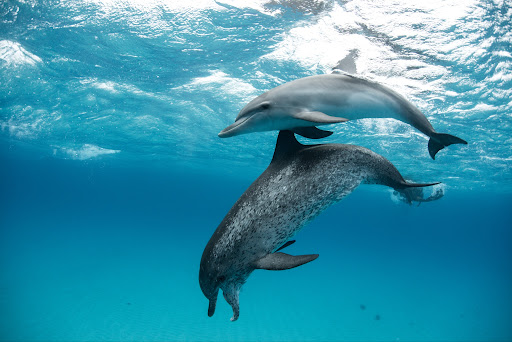
Pantropical spotted dolphins are relatively small, reaching lengths of 6 to 7 feet and weighing approximately 250 pounds at adulthood. They have long, slender snouts or beaks. Like the Atlantic spotted dolphin, pantropical spotted dolphins do not have spots at birth but accumulate them as they age until they are almost completely covered with overlapping patterns. They are also distinguished by a dark cape or coloration on their backs—stretching from their head to almost midway between the dorsal fin and the tail flukes—and by a white-tipped beak.
Behavior and Diet
Pantropical spotted dolphins usually occur in groups of several hundred to 1,000 animals. They are considered quite social, often schooling with other dolphin species. Although their specific migratory patterns have not been clearly described, they seem to move inshore in the fall and winter months and offshore in the spring.
Pantropical spotted dolphins spend most of their day in shallower water between 300 and 1,000 feet deep. At night, they dive into deeper waters to search for prey. They feed primarily on mesopelagic cephalopods and fish.
Where They Live
Pantropical spotted dolphins can be found in all tropical and subtropical oceans worldwide. The depleted northeastern offshore spotted stock inhabits the eastern tropical Pacific Ocean, far at sea. Coastal spotted dolphins are found within 100 miles of the coast. In addition, a Hawaiian stock occurs throughout the Hawaiian Islands.
In the Hawaiian archipelago, there are genetically distinct populations of pantropical spotted dolphins found between Hawaiߵi Island, Maui Nui, Oߵahu, and offshore. Animals from each population can travel 120 to 300 miles offshore, but they are generally found closer to the islands.
Lifespan & Reproduction
The maximum lifespan for pantropical spotted dolphins is 46 years. Maturity occurs around age 11. Mating and calving occurs year-round, with gestation lasting around 11 months. Lactation usually lasts 2 years, but it may be as few as for 1 year. At 3 to 6 months old, however, calves will begin eating solid food. Calving intervals depend on the population, but they range from 2.5 to 4 years.
Threats
Entanglement
One of the main threats to pantropical spotted dolphins is becoming entangled or captured in commercial fishing gear. Entanglement is particularly threatening for the northeastern offshore spotted stock in the eastern tropical Pacific Ocean. Some species of tuna are known to aggregate beneath groups of northeastern offshore spotted dolphins in the eastern tropical Pacific. This close association led to the fishing practice of encircling a spotted dolphin school to capture the tuna concentrated below, to the detriment of the dolphin population, which were incidentally bycaught in the nets.
Illegal Feeding and Harassment
Because pantropical spotted dolphins are common and abundant throughout the Hawaiian archipelago (where they are the second most frequently sighted species during nearshore surveys), interactions with people are a growing issue for the Hawaiian stock. Illegal feeding and harassment of these dolphins have been reported.
Hunting
Pantropical spotted dolphins are hunted for food in Asia, Indonesia, the Philippines, and parts of the Pacific.
Bottlenose Dolphin
- Scientific Name: Tursiops truncates
- Length: 13 feet
- Weight: 660 pounds
- Numbers: Gathering numbers and data
The Bottlenose Dolphin is considered to be the most beloved and most instantly recognizable of ocean animals. At 600 pounds they are the size of a bear and two times the size of the Spotted and Spinner Dolphins.
Their nose has a gray coloration and is slightly thicker.
They live in the reefs of the Hawaiian islands, follow boats and are known the be very friendly.
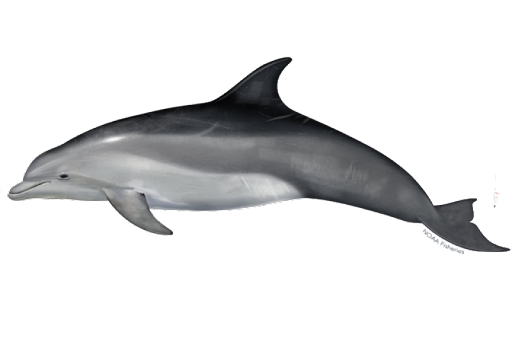
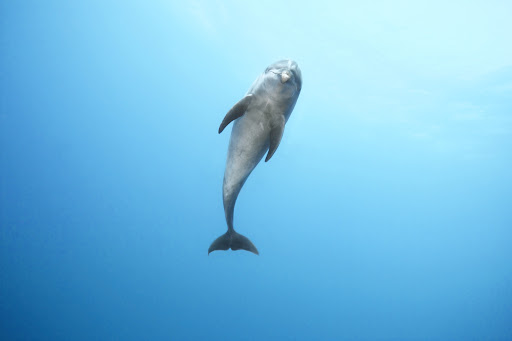
Common bottlenose dolphins (referred to hereafter simply as bottlenose dolphins) are found throughout the world in both offshore and coastal waters, including harbors, bays, gulfs, and estuaries of temperate and tropical waters (estuaries are the areas where rivers meet the sea). They are one of the most well-studied marine mammals in the wild. In addition, they are easy to view in the wild because they live close to shore and are distributed throughout coastal and estuarine waters. But this puts bottlenose dolphins at increased risk of human-related injuries and death. They are a highly intelligent species and use sound both for communication and to hunt for food.
Bottlenose dolphins in the United States are not endangered or threatened under the Endangered Species Act (ESA), but they are protected under the Marine Mammal Protection Act (MMPA). They are vulnerable to many stressors and threats including disease, biotoxins, pollution, habitat alteration including freshwater incursions, vessel strikes, human feeding of and activities causing harassment, interactions with commercial and recreational fishing, energy exploration and oil spills, and other types of human disturbance, such as underwater noise.
Behavior and Diet
Bottlenose dolphins may travel alone or in groups, and the groups often break apart and reform. Their travel is characterized by persistent movement in a consistent direction. Resting is often characterized by tight group formations, slow movement, and intervals of methodical breathing.
Social behavior includes breeding, playing, aggression, and gentle body contact, such as rubbing. Calves maintain what is called “baby position” while swimming. In this position, the calf has easy access to nursing and may gain benefits by reducing drag from swimming in it’s mom’s slip stream. When in baby position, the mom surfaces first, and the calf surfaces slightly after and just behind and to the side of its mother.
Bottlenose dolphins can thrive in many environments and feed on a variety of prey, such as fish, squid, and crustaceans (e.g., crabs and shrimp). They use different techniques to pursue and capture prey, searching for food individually or cooperatively. For example, they work together to herd fish into groups and then take turns charging through the school of fish to feed. They may also trap schools of fish against sand bars and seawalls for an easy meal. They also use passive listening and/or high frequency echolocation to locate prey.
Instead of using their teeth to chew, dolphins grip fish with their teeth, then swallow the fish whole—head first—so the spines of the fish don’t catch in their throats.
Rough-Tooth Dolphin
- Scientific Name: Steno bredanesis
- Length: 8.5 feet
- Weight: 200-340 pounds
- Numbers: Gathering numbers and data
The Rough-toothed Dolphins are deep divers and can be seen in the deeper parts of the Hawaii islands. They are friendly and known the follow boats and show up to interact with divers.
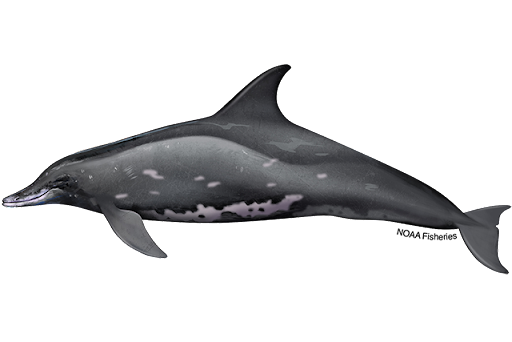
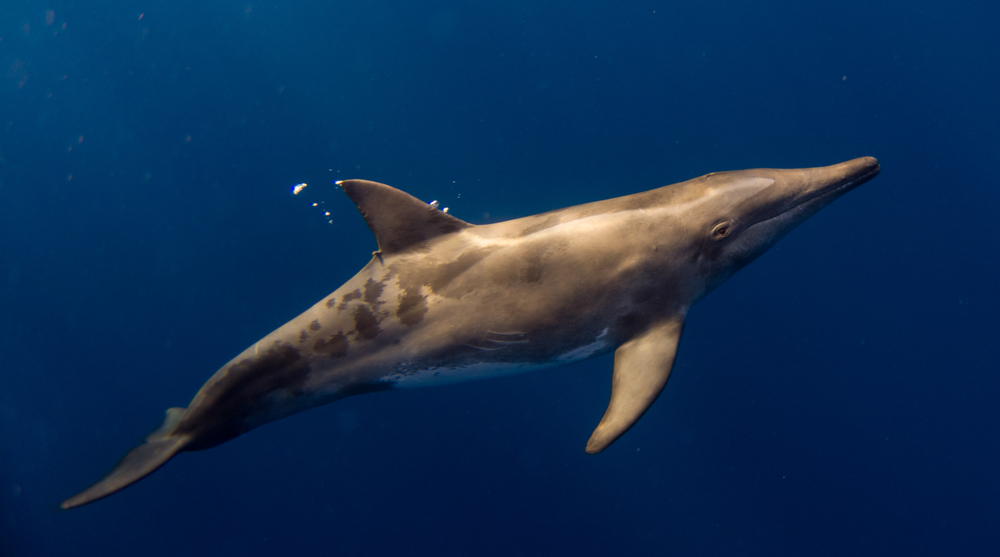
Rough-Tooth Dolphin
Rough-toothed dolphins are found throughout the world in tropical and warmer temperate waters. These small members of the dolphin family usually travel in small, tight-knit groups of two to 20 individuals. Their common name was based on the ridges found on their teeth, which are unique to this species.
Rough-toothed dolphins can remain underwater for up to 15 minutes. They can also adapt well to captivity, which is unusual for oceanic dolphins
Appearance
Rough-toothed dolphins are relatively small compared to other dolphins. They can reach up to 8.5 feet in length and weigh about 350 pounds. They have a small head with a long rostrum and no demarcation between their gently sloping melon (or forehead) and rostrum. Their dorsal fin and pectoral fins or flippers are distinctively large, which is characteristic of this species. They have a “reptilian” appearance that is also distinct and unique among dolphins.
Rough-toothed dolphins have dark gray bodies with a white throat and “lips.” They also have a narrow dark cape that runs down their back between the blowhole and dorsal fin. Their underside usually has some white or lighter spots or blotches.
Behavior and Diet
Rough-toothed dolphins are usually found in tight-knit groups of approximately 10 to 20 individuals. However in Hawaii, they are found in smaller groups of on average three individuals and a median group size of seven; they are rarely observed in larger groups of up to 100 individuals. They often associate with other cetacean species, including short-finned pilot whales, bottlenose dolphins, pantropical spotted dolphins, and spinner dolphins. They eat squid and different types of fish.
False Killer Whale
- Scientific Name: Pseudorca cassidens
- Length: 14-17 feet
- Weight: 2,600 pounds
- Status: Endangered and under serious concern
There are actually three false killer whale populations in Hawaii: pelagic, Northwestern Hawaiian Islands insular, and the currently endangered Main Hawaiian Islands insular. The name “false killer whale” is in itself misleading, as it looks nothing like a true killer whale.
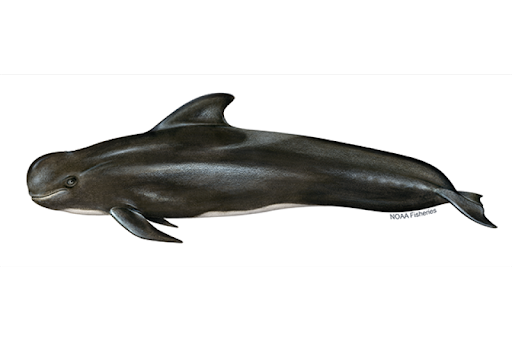
It’s dark grey in color and like the Pilot Whale, also is not a whale and is in fact a dolphin. All dolphins are actually whales, but not all whales are dolphins. They get their name from the similarities between the skulls and teeth of the Orca and the False Killer Whale.
The False Killer Whale is the most social of all the whales, going as far as to share prey with one another and, if you’re lucky, they’ll offer food to boaters and divers as well. They’re found usually around the Northwestern Islands year-round.
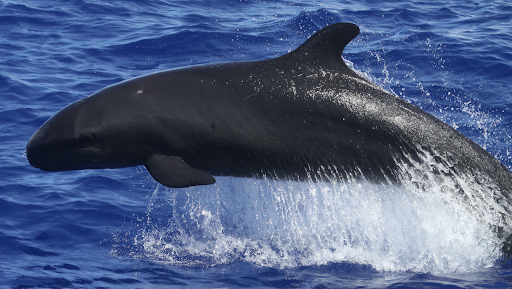
Short-finned pilot whales are found globally in tropical and temperate oceans. They are one of two species of pilot whale, along with the long-finned pilot whale. The two species differ slightly in size, features, coloration, and pattern. In the field and at sea, it is very difficult to tell the difference between the two species.
Short-finned pilot whales are long-lived, slow to reproduce, and highly social. They live in stable groups of 15 to 30 animals composed of close family relatives, and tend to live in localized, resident populations, although some populations have wider ranges. Their diet consists primarily of squid, with a small amount of fish. They are commonly found along the coast close to the continental shelf, although some populations have been found to extend into deep, open ocean environments such as in the eastern tropical Pacific Ocean. Pilot whales are often involved in mass strandings for reasons that are still unclear.
Three stocks of short-finned pilot whales are recognized in U.S. waters, which live along the U.S. east and west coasts, and around the Hawaiian Islands. On the west coast, short-finned pilot whales were once commonly seen, with an apparently resident population around Santa Catalina Island. After a strong El Niño in 1982 and 1983, short-finned pilot whales virtually disappeared from this area, and there are now thought to be about 800 animals in the West Coast stock. About 23,500 animals comprise the East Coast stock, around 2,000 in the Gulf of Mexico stock, and about 9,000 animals in the Hawaiian stock.
Lifespan & Reproduction
The oldest estimated age of false killer whales (based on growth layers in teeth) is 63 years for females and 58 years for males.
Female false killer whales reach sexual maturity between the ages of 8 and 11, while males mature 8 to 10 years later. Gestation ranges from 11 to 16 months, and lactation occurs for 1.5 to 2 years. Time between births is unknown but is estimated to be around 7 years. Female false killer whales enter menopause and become less reproductively successful between 44 and 55 years old.
SHORT-BEAKED COMMON DOLPHIN
- Scientific Name: Delphinus delphis
- Length: 5-8 feet
- Weight: 220-299 pounds
- Status: Not endangered but under protection from the Marine Mammal Protection Act
There are more Short-beaked Common Dolphins than any other dolphin species in the warm-temperate portions of the Atlantic and Pacific Oceans. They prefer the shores and the reefs along all the islands, generally on the sides closest to the mainland.
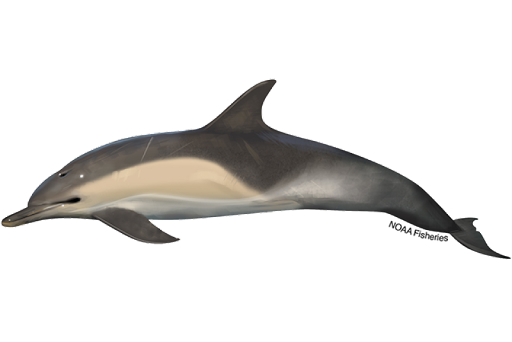
The color pattern on this dolphin is unusual for a dolphin. Their back is a dark grey ranging to black with a white underbelly and they have a light grey, yellow, or gold hourglass pattern on both their sides. They’re found year-round and are rarer than many of these other species as they’re much shyer of boats and people.
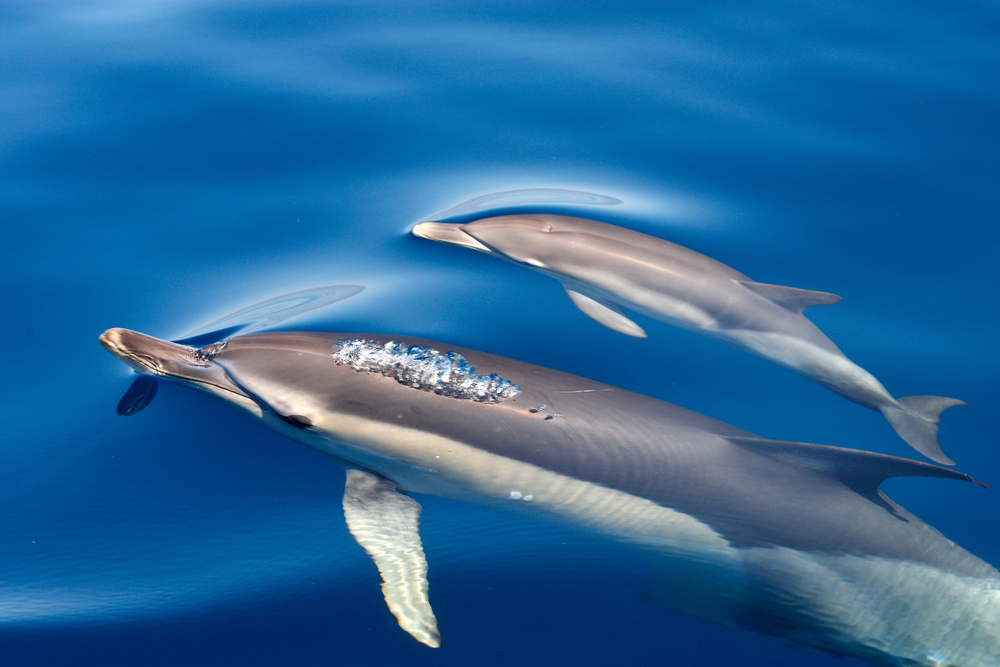
Behavior and Diet
Short-beaked common dolphins are usually found in large social groups averaging hundreds of individuals and are occasionally seen in larger groups—known as mega-pods—consisting of thousands of animals (up to 10,000 individuals). These large groups are thought to consist of sub-groups of 20 to 30 individuals that are possibly related or separated by age and/or sex.
Short-beaked common dolphins are often active at the surface. These highly social, energetic dolphins commonly leap out of the water at high speeds, flip end-over-end, and somersault in the air. They will also swim alongside ships riding the bow for long periods of time. This “bow riding” behavior has even been observed alongside large whales.
Short-beaked common dolphins usually rest during the day and feed at night. They can dive to approximately 1,000 feet but typically dive to about 100 feet to feed on schooling fish and cephalopods (e.g., squid) that migrate towards the surface at night. Short-beaked common dolphins associate with schools of tuna and seabird-feeding flocks, especially in the eastern tropical Pacific Ocean. They have also been observed in mixed groups with spinner dolphins and striped dolphins.
Lifespan & Reproduction
Short-beaked common dolphins have an estimated lifespan of up to 35 years. On average, males become sexually mature at 10 years and females at 8 years, although individuals may become sexually mature between 5 and 12 years. Off the California coast, calving takes place during the winter months after a 10- to 11-month gestation period, whereas calving takes place year-round in the eastern tropical Pacific Ocean. Every 2 to 3 years, adult females give birth to a single calf that is about 2.5 to 3 feet long. Calves begin to wean after about 1 year, but remain dependent on their mother for another year or more.
Threats
Entanglement in Fishing Gear
One of the main threats to short-beaked common dolphins is getting caught in fishing gear. They can become entangled or captured in commercial fishing gear such as gillnets, seines, trawls, trap pots, and longlines. Many fisheries in the Atlantic Ocean capture short-beaked common dolphins as bycatch, and they have the highest mortality rate of all cetaceans affected by the drift gillnet fishery operating off the coast of California.
Hunting
Russia, Japan, and nations bordering the Black Sea and the Mediterranean Sea, hunt short-beaked common dolphins for their meat and oil.
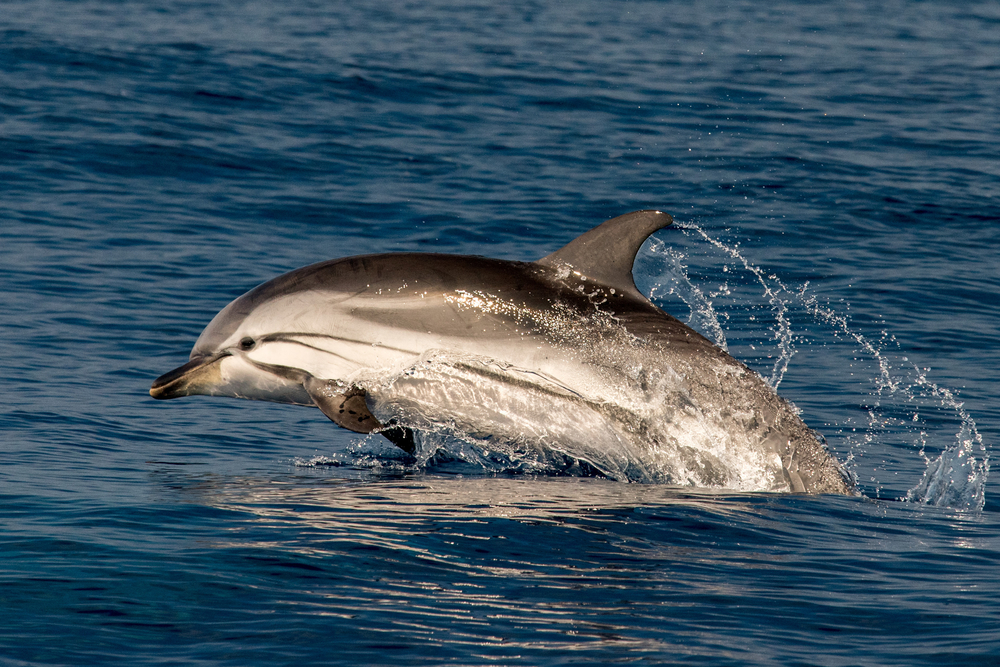
STRIPED DOLPHIN
- Scientific Name: Stenella coeruleoalba
- Length: 7.9-8.5 feet
- Weight: 330-350 pounds
- Status: Not endangered or threatened
The Striped Dolphin gets its name from its coloration, like most of the family. Their underside is blue, white, or pink and has two more black stripes running across the back from their eyes to their flipper.
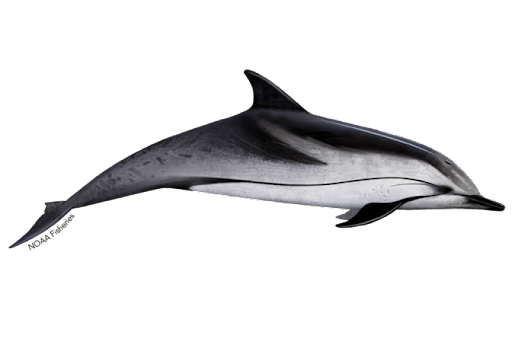
The dolphins in the Pacific near the Hawaiian islands are unique in that they display migration patterns that others in other regions don’t. This means that the best time to see this more elusive dolphin is around the islands during the late Spring and Summer months.
Behavior and Diet
Striped dolphins are usually found in tight, cohesive groups averaging between 25 and 100 individuals, but they have occasionally been seen in larger groups of up to several hundred and even thousands of animals. Within these groups, there is a complex system of individuals that may be organized by age, sex, and breeding status. Striped dolphins rarely associate with other species of whales, dolphins, and seabirds.
Their surface behavior is often characterized as sociable, athletic, energetic, active, and nimble with rapid swimming. They can often be observed breaching, roto-tailing (a circular motion using the tail while jumping out of the water), jumping, and leaping 20 feet above the surface. In the eastern tropical Pacific Ocean, field biologists and fishermen call striped dolphins “streakers” because they avoid vessels by rapidly swimming away.
Striped dolphins feed throughout the water column on a diverse diet of fish and cephalopods (e.g., squid and octopus). They are capable of diving to at least 2,300 feet.
Where They Live
Striped dolphins prefer tropical to warm temperate waters (52 to 84° F) that are oceanic and deep. They are mainly found in waters seaward of the continental shelf from 50° North to 40° South and are often linked to upwelling areas and convergence zones.
Striped dolphins are found worldwide. Their range includes waters off Greenland, northern Europe (United Kingdom, Denmark), the Mediterranean Sea, Japan, Argentina, South Africa, western Australia, and New Zealand.
In the United States, they can be found off the west coast, in the northwestern Atlantic, and in the Gulf of Mexico. They also live in the waters off Hawai‘i, but do not live in the colder temperate and boreal waters of Alaska. This species has been documented outside its normal range in areas such as the Faroe Islands, Denmark’ southern Greenland; the Kamchatka Peninsula, Russia; and Prince Edward Island, Canada.
Lifespan & Reproduction
The estimated lifespan of striped dolphins is up to 58 years. They become sexually mature when they reach about 7 feet in length—between the ages of 5 and 13 years for females and 7 and 15 years for males. Their mating system is generally unknown, but is thought to be polygynous, meaning one male mates with more than one female. Every 3 to 4 years, females give birth to a single 3-foot-long calf during the summer or autumn after a gestation period of about 1 year. Lactation lasts 12 to 18 months.
Dolphin News